You are navigating an evolving landscape in the professional cleaning industry. The traditional mop and bucket are gradually being supplemented, and in some areas, replaced, by an array of technological advancements designed to enhance efficiency, sustainability, and the overall quality of your services. Understanding these shifts is crucial for maintaining a competitive edge and delivering superior results to your clients.
Optimizing Operations Through Smart Data and Scheduling
The days of rigid, pre-set cleaning schedules are becoming less common. You are now able to leverage digital tracking systems that provide real-time insights into your clients’ facilities. These systems monitor critical data points, such as traffic patterns and occupancy levels. For instance, in a corporate office building, the system can identify that the lobby experiences peak foot traffic between 8:00 AM and 10:00 AM, and again from 4:00 PM to 6:00 PM. Similarly, restroom usage can be tracked, indicating when they are most heavily utilized.
This data-driven approach allows you to move beyond a static cleaning regimen. Instead, you can direct your resources precisely where and when they are most needed. If a particular restroom has seen an unusually high number of users, the system will flag it, prompting your team to prioritize its cleaning and disinfection. This minimizes instances of over-cleaning less-used areas and under-cleaning high-traffic zones. The result is a more efficient allocation of your workforce, ensuring that cleaning efforts are focused on critical areas like lobbies and restrooms, which are not only high-traffic but also crucial for client perception. This approach translates to reduced labor hours spent on unnecessary tasks and improved satisfaction for your clients, who benefit from consistently clean and well-maintained environments.
Real-time Monitoring and Dynamic Allocation
Imagine a scenario where a large retail store experiences an unexpected surge in shoppers due to a special event. Your smart scheduling system, integrated with the store’s foot traffic sensors, will immediately detect this increase. You can then dynamically reallocate staff to frequently touched surfaces, like checkout counters and shopping cart handles, which would otherwise be prone to increased contamination during such busy periods. This agility prevents potential hygiene issues before they escalate, maintaining a high standard of cleanliness even during unforeseen circumstances.
Predictive Maintenance for Supplies
Beyond workforce allocation, these data systems can also predict supply needs. By analyzing the frequency and intensity of cleaning in specific areas, the system can project when cleaning solutions, paper towels, or soap dispensers will need replenishment. This predictive capability allows you to optimize inventory management, reducing the likelihood of running out of essential supplies and streamlining your procurement process. You’re no longer reacting to shortages; you’re proactively preventing them.
Integrating Robotic Automation into Your Workflow
Robotic automation is no longer a futuristic concept but a practical reality for professional cleaning. You are seeing a growing presence of autonomous vacuums, floor scrubbers, and even window-washing drones in large facilities. These machines are designed to execute repetitive, physically demanding tasks with consistent precision. Consider the vast expanses of a warehouse floor or the extensive corridors of a hospital. Manually scrubbing or vacuuming these areas is time-consuming and labor-intensive. Autonomous scrubbers can methodically cover these areas, ensuring a uniform clean without requiring constant human oversight.
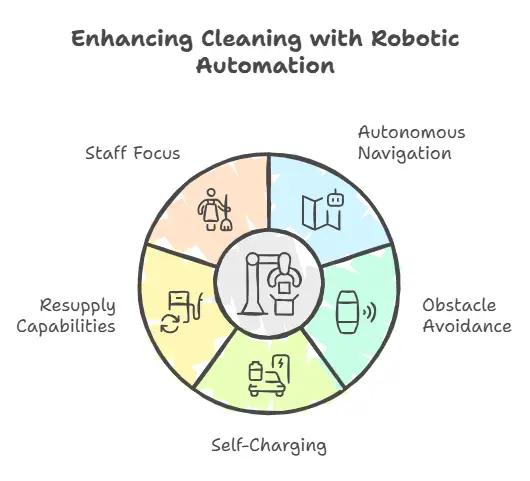
The primary benefit you gain from this technology is the ability to free up your trained staff. Instead of performing mundane, repetitive tasks, your human cleaners can now focus their expertise on more nuanced and critical aspects of cleaning. This includes detailed work, such as meticulously sanitizing hard-to-reach areas, performing targeted disinfection on high-touch surfaces like doorknobs and light switches, and addressing specific client requests that require a human eye and touch. Furthermore, the latest generation of autonomous cleaners are equipped with advanced sensors and AI. They can navigate complex environments, avoid obstacles like furniture or people, and even return to their docking stations independently for battery recharging or to refill their cleaning solutions. This independent functionality minimizes human intervention and maximizes operational uptime.
Autonomous Navigation and Obstacle Avoidance
Think about a busy office environment where furniture is constantly being moved or people are walking around. Older robotic systems might have struggled with such dynamic environments, frequently getting stuck or requiring human intervention. Modern autonomous cleaners, however, utilize sophisticated LiDAR and camera systems, allowing them to create detailed maps of their surroundings, detect obstacles in real-time, and adapt their cleaning paths accordingly. This ensures uninterrupted operation and a more thorough clean, even in complex, changing environments.
Self-Charging and Resupply Capabilities
A significant advancement in robotic cleaning is the ability for these machines to manage their own power and supplies. For example, when an autonomous floor scrubber detects its battery is low, it will navigate back to its charging station without human input. Similarly, some models can automatically dock and replenish their cleaning solution tanks, allowing for extended periods of operation. This self-sufficiency greatly reduces the need for constant human monitoring and intervention, maximizing the efficiency of your robotic fleet.
Enhancing Hygiene with Advanced Disinfection Technologies
The importance of disinfection has come to the forefront in recent years, and you are increasingly relying on advanced technologies to ensure superior hygienic standards. Electrostatic spraying systems represent a significant leap forward in applying disinfectants. Unlike traditional spray methods, electrostatic sprayers impart a positive electrical charge to the disinfectant droplets. This causes the droplets to be attracted to negatively charged surfaces, providing an even and comprehensive coverage, even on complex or out-of-reach geometries. For you, this means that every surface, including the undersides of desks, the intricate patterns of a chair, or the grooves of a handrail, receives a consistent layer of disinfectant. This uniform application is critical for achieving the manufacturer’s specified dwell times, which are essential for the disinfectant to effectively neutralize pathogens.
Beyond application, you are also employing touchpoint sanitation tracking. This involves systematically identifying and monitoring frequently touched surfaces within a facility, such as door handles, elevator buttons, shared keyboards, and light switches. Using dedicated software or checklists, your teams can ensure these critical touchpoints are regularly cleaned and disinfected according to established protocols. This targeted approach significantly reduces the risk of germ transmission in high-traffic areas. Furthermore, the application of hospital-grade disinfectants, rigorously selected for their efficacy against a broad spectrum of pathogens, combined with strict adherence to proper dwell times, ensures that your disinfection protocols meet or exceed industry standards, thereby protecting the health and safety of your clients and their occupants.
Ensuring Dwell Time Adherence
The efficacy of any disinfectant hinges on its dwell time – the amount of time the product must remain wet on a surface to kill pathogens. Traditional spraying methods often result in uneven coverage, leading to quick evaporation in some areas and thus insufficient dwell time. Electrostatic spraying mitigates this issue by creating a uniform coat of disinfectant that adheres effectively, allowing you to consistently meet the required dwell times across all treated surfaces. This meticulous application eliminates guesswork and ensures your disinfection efforts are truly effective.
ATP Testing for Verification
To further validate your disinfection protocols, you can incorporate ATP (Adenosine Triphosphate) testing. ATP meters measure the amount of organic residue left on a surface after cleaning and disinfection. While not directly measuring pathogens, a low ATP reading indicates a high level of cleanliness. You can use this technology as a quality assurance tool, performing immediate checks after disinfection to ensure the effectiveness of your processes and provide tangible proof of cleanliness to your clients.
Implementing Sustainable Cleaning Solutions
The shift towards sustainable practices is not merely a trend; it’s a fundamental change in the way you approach professional cleaning. You are increasingly adopting methods and products that minimize environmental impact while maintaining, or even enhancing, cleaning standards. Low-moisture cleaning systems are a prime example. These systems, whether for carpets or hard floors, significantly reduce water consumption compared to traditional methods. For instance, some carpet cleaning systems use foam or encapsulation techniques that require substantially less water, resulting in faster drying times and reducing the risk of mold and mildew growth. Similarly, low-moisture floor scrubbers can clean large areas using a fraction of the water typically required.
Chemical dilution control systems are another cornerstone of your sustainable approach. These systems ensure that cleaning concentrates are accurately diluted, eliminating guesswork and preventing the overuse of chemicals. This not only reduces the amount of chemicals released into the environment but also minimizes waste and optimizes your operational costs. Microfiber technology is now standard practice due to its superior cleaning power and water retention capabilities, allowing for effective cleaning with fewer chemicals and less water. Furthermore, you are investing in energy-efficient equipment, such as vacuum cleaners and floor buffers with optimized power consumption. Crucially, your choice of cleaning products is increasingly leaning towards those certified by reputable organizations like Green Seal and EPA Safer Choice. These certifications assure you and your clients that the products meet stringent environmental and health standards, reducing exposure to harsh chemicals and promoting a healthier indoor environment.
Reducing Water Waste with Foam and Encapsulation
Consider the traditional method of deep carpet cleaning, which often involves saturating the carpet with water and cleaning solutions, followed by extensive extraction. This process is water-intensive and can lead to long drying times. With low-moisture foam or encapsulation systems, you’re applying a minimal amount of solution that encapsulates dirt particles. These encapsulated particles are then easily removed by vacuuming, drastically reducing water usage and allowing treated carpets to dry within hours, not days. This not only conserves a precious resource but also minimizes disruption to your client’s operations.
Certified Green Products and Their Benefits
The selection of cleaning chemicals has a direct impact on both environmental and human health. By opting for Green Seal and EPA Safer Choice certified products, you are making a conscious decision to use formulations that are less toxic, biodegradable, and derived from renewable resources where possible. These products significantly reduce the release of volatile organic compounds (VOCs) into the air, improving indoor air quality for building occupants and your staff alike. This commitment extends beyond environmental responsibility; it’s about providing a healthier working and living environment for everyone involved.
Elevating Efficiency Through Improved Tool Design
The evolution of cleaning tools might seem subtle, but these design improvements significantly impact your team’s efficiency and physical well-being. You are moving beyond traditional tools towards innovative designs that address previous bottlenecks and physical strains. Single-use disposable microfiber options, for example, eliminate the logistical challenge and cost associated with laundering reusable microfiber cloths. In high-stakes environments, where preventing cross-contamination is paramount, disposable microfiber provides immediate peace of mind. After a single use, it’s discarded, ensuring that no germs are inadvertently transferred from one area to another.
Beyond disposables, the design of reusable tools has also seen significant enhancements. Mop pads are engineered with improved glide characteristics, reducing the physical effort required to maneuver them across various floor surfaces. This minimizes strain on your staff, particularly when cleaning large areas. Similarly, wipes are now available with dilution indicators, which change color or texture to signal optimal saturation with cleaning solutions, preventing both overuse and under-use of chemicals. Autoscrubber pads are also designed for better performance and longevity, requiring fewer replacements and providing a more consistent clean. These seemingly minor design changes collectively contribute to a more efficient cleaning process, reducing the time spent on tasks and minimizing the physical toll on your cleaning professionals.
Ergonomics and Reduced Physical Strain
Think about the repetitive motions and physical exertion involved in traditional mopping or scrubbing. Newer tool designs incorporate ergonomic principles to minimize the impact on your staff. Lighter materials, adjustable handles, and improved weight distribution in tools like backpack vacuums all contribute to a significant reduction in physical strain. This not only makes the job less arduous but also helps prevent work-related injuries, ensuring a healthier and more productive workforce.
Microfiber’s Enhanced Cleaning Power
The evolution of microfiber technology itself is noteworthy. Modern microfiber cloths and mop pads are designed with an even greater density of microscopic fibers, allowing them to capture and hold more dirt, dust, and microscopic particles than conventional materials. This enhanced cleaning power means you can achieve a superior clean with less effort and, in many cases, without the need for harsh chemicals, further supporting your sustainability goals.
Optimizing Team Performance with Digital Workforce Management
In an increasingly complex operational environment, you leverage digital workforce management tools to enhance accountability, transparency, and overall team performance. Facial recognition time clocks, for instance, are being adopted to accurately track attendance and punctuality. This eliminates the potential for “buddy punching” and provides precise data on employee work hours, streamlining payroll processes and ensuring fairness.
Beyond simple time tracking, you are utilizing sophisticated QA software for inspection tracking. This software allows supervisors to conduct thorough inspections of cleaned areas, document findings, and assign corrective actions. The system can generate detailed reports, identifying trends in performance, offering insights into areas that require additional training, and providing verifiable proof of service quality to your clients. Furthermore, integration with building systems allows you to monitor key performance indicators (KPIs) in real-time. This could include metrics such as average time taken to clean a specific area, disinfectant usage rates, or the frequency of resolving service requests. By having access to this data, you can make informed decisions about resource allocation, process improvements, and staff training, ultimately leading to a more efficient and accountable cleaning operation. This level of digital oversight ensures that your services are consistently meeting high standards and that you have the data to back it up.
Real-time Performance Monitoring
Imagine being able to see, at any given moment, the progress of your cleaning teams across multiple client locations. Digital dashboards, integrated with your workforce management system, provide a real-time overview of completed tasks, areas still requiring attention, and any potential delays. This allows you to proactively address issues, reallocate resources if necessary, and ensure service level agreements are met, enhancing your responsiveness and reliability.
Client-Facing Transparency
These digital tools also offer an opportunity for greater transparency with your clients. Through secure client portals, you can provide them with access to cleaning schedules, completed task lists, and even inspection reports. This level of openness builds trust and demonstrates your commitment to quality and accountability. It transforms the client relationship from a transactional one to a partnership based on clear communication and verifiable performance.
Adapting Your Workforce Through Specialized Training
The proliferation of advanced technology in professional cleaning necessitates a significant evolution in the roles and skills of your cleaning staff. As automation takes on more of the routine, physically demanding tasks, your employees are transitioning into new roles that require a different skillset. You are seeing a clear shift towards what can be termed “robotic technicians.” This means your staff members are no longer solely focused on manual cleaning; they are now responsible for operating, monitoring, and maintaining the sophisticated robotic equipment that forms an integral part of your service delivery.
This shift requires specialized training programs. Your staff need to be proficient in programming robotic scrubbers, understanding their error codes, performing routine maintenance like changing brushes or filters, and ensuring their optimal functionality. They also need to be trained in troubleshooting common issues, understanding sensor data, and effectively collaborating with autonomous machines. Beyond robotics, training also extends to the proper use of advanced disinfection technologies, data interpretation from smart scheduling systems, and the application of sustainable cleaning practices. This investment in your workforce is critical; it empowers your employees with new skills, enhances their long-term career prospects, and ensures that you can effectively leverage the full potential of your technological investments. Your cleaning staff are becoming more highly skilled professionals, capable of managing a blend of manual expertise and technological oversight.
Upskilling for New Technologies
Consider the complexity of operating and maintaining a fleet of autonomous floor scrubbers. Your staff need to be trained not just on how to start and stop these machines, but also on how to program cleaning routes, interpret diagnostic messages on touchscreens, and perform basic maintenance like replacing cleaning solution and wastewater tanks. This requires a different set of skills than traditional cleaning, moving towards a more technical and analytical role.
Safety Protocols for Advanced Equipment
The introduction of new technologies also necessitates updated safety protocols. Staff need to be trained on the safe operation of robotic equipment, including understanding exclusion zones, emergency stop procedures, and the proper handling of specialized chemicals used in advanced disinfection systems. This ensures a safe working environment for your employees and prevents damage to expensive equipment, underscoring the importance of comprehensive training in the digital age of cleaning.
FAQs
What are some of the latest innovations in the professional cleaning industry?
Some of the latest innovations in the professional cleaning industry include robotic cleaners, electrostatic sprayers, and UV-C disinfection technology.
How are robotic cleaners changing the professional cleaning industry?
Robotic cleaners are changing the professional cleaning industry by automating repetitive tasks, increasing efficiency, and reducing the need for manual labor.
What is electrostatic sprayer technology and how is it impacting professional cleaning?
Electrostatic sprayer technology is a method of applying disinfectants and sanitizers to surfaces using electrostatic charges, resulting in more even coverage and reduced waste. It is impacting professional cleaning by improving disinfection processes and reducing the spread of germs.
How is UV-C disinfection technology being used in the professional cleaning industry?
UV-C disinfection technology is being used in the professional cleaning industry to kill bacteria and viruses on surfaces using ultraviolet light. It is an effective and chemical-free method of disinfection.
What are the benefits of these innovations for professional cleaning companies?
The benefits of these innovations for professional cleaning companies include increased efficiency, improved cleaning results, reduced labor costs, and enhanced safety for cleaning staff and building occupants.